Nina’s first-author paper is out!
7.8 CiteScore
6.0 Impact Factor
Abstract
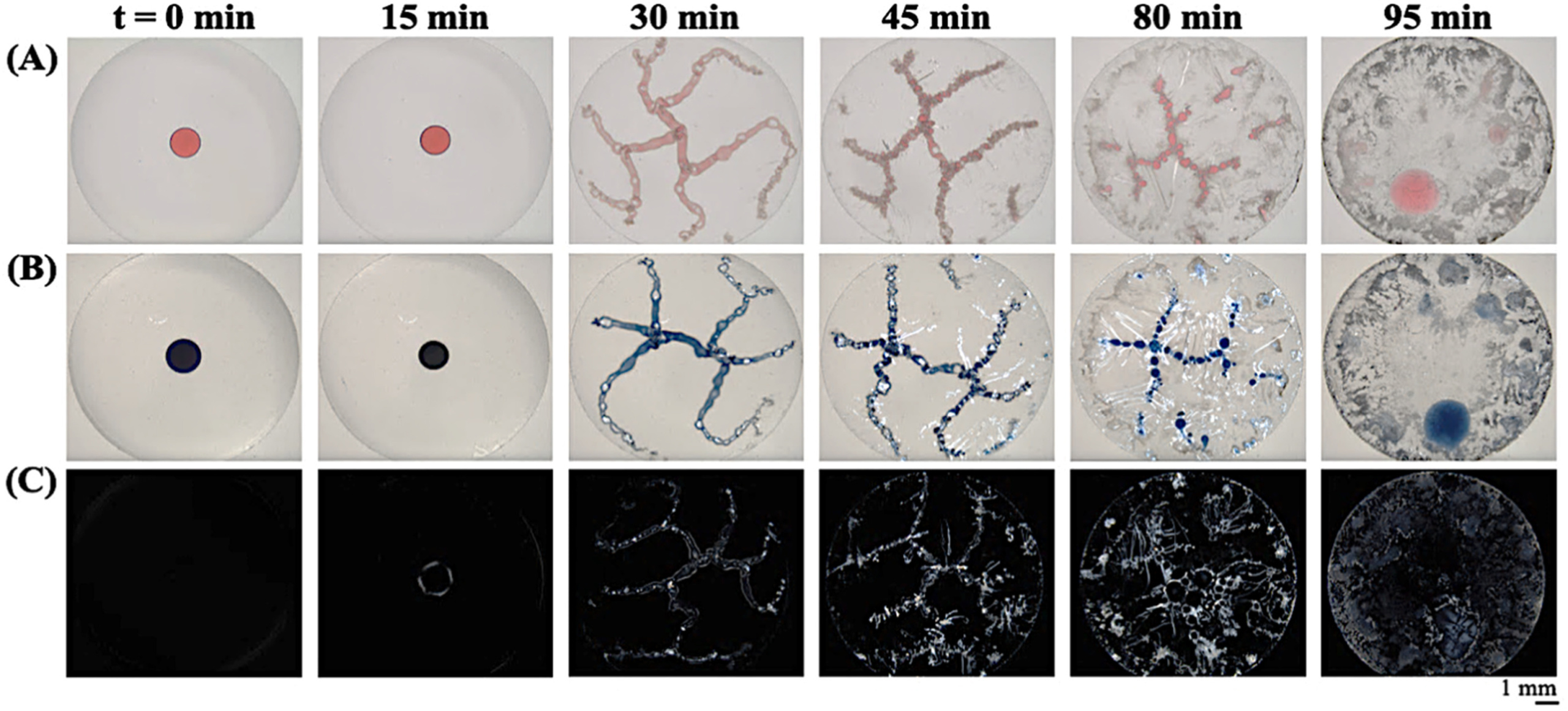
Self-organization is a hallmark of living systems, and non-living systems that mimic natural structures can provide valuable insight into the fundamental factors driving shape transformations, such as elasticity and molecular interactions. Here, we demonstrate that a simple, lipid-free decanol-sodium decanoate system can mimic complex biological morphologies, including anisotropic domains and myelin figures. Combining experimental observations with a phase-field hydrodynamic model, we show that gradients in surfactant concentration govern the onset and evolution of these structures. Notably, the critical concentration threshold for anisotropy aligns closely with the system’s critical micelle concentration. Furthermore, salt type and concentration modulate the dynamics and extent of myelin figure growth. The associated phase-field model captures essential features of the morphological evolution, emphasizing the role of interfacial flows driven by concentration gradients in finger formation. This work deepens the mechanistic understanding of surfactant-mediated self-assembly in minimal chemical environments and contributes to the design of adaptive soft materials inspired by biological complexity.